[vc_row full_width=”stretch_row” full_width_header_sticky=”0″ desktop_bg_image_position=”bg-position-center-top” hongo_enable_responsive_css=”1″ css=”.vc_custom_1616735572087{margin-top: 50px !important;padding-bottom: 80px !important;background-image: url(https://staging.aya.africa/wp-content/uploads/2021/03/Screen-Shot-2021-03-26-at-12.09.55-AM.png?id=106734) !important;}” responsive_css=”.hongo_responsive_1616735572089{margin_top_mobile:10px},”][vc_column hongo_column_animation_style=”none” desktop_alignment=”text-center” width=”5/6″ offset=”vc_col-md-offset-2 vc_col-md-8 vc_col-sm-offset-1 vc_col-xs-12″ css=”.vc_custom_1600638687652{margin-top: -10% !important;}”][hongo_section_heading hongo_heading_type=”heading-style-2″ hongo_heading=”IN CONVERSATION- MELISSA ROMULUS AND THE PANBLACK TONE” hongo_font_title_setting=”.hongo_font_1616737957130{font_lg:60px|line_lg:60px|weight_lg:text-lg-400|color_title:%23ffffff|font_xs:20px|align_xs:text-xs-center},” css=”.vc_custom_1616737957131{border-bottom-width: 50% !important;padding-top: 30% !important;}”][/vc_column][/vc_row][vc_row css=”.vc_custom_1543040072800{padding-top: 0px !important;padding-bottom: 0px !important;}”][vc_column css=”.vc_custom_1600645126842{margin-top: 50px !important;}”][hongo_blockquote hongo_blockquote_style=”blockquote-style-2″ hongo_icon_size=”icon-medium” hongo_blockquote_author=”THE PAN BLACK TONE” hongo_font_auther_setting=”.hongo_font_1616937331736{align_lg:text-lg-center|align_lt:text-lt-center|align_md:text-md-center|align_sm:text-sm-center|align_xs:text-xs-center},”]
“As you explore Melissa’s work, and even through our conversation, the feminine form is dominant, it appears to be Melissa’s protagonist, usually front and center and bold in character paying attention mainly to women’s issues”
[/hongo_blockquote][vc_column_text hongo_enable_responsive_css=”1″ css=”.vc_custom_1626091434247{margin-bottom: 0px !important;}” responsive_css=”.hongo_responsive_1626091434249{padding_top_laptop:50PX},”] In conversation, with Melissa RomulusHey, it’s your girl Kilali from THE PANBLACK TONE (TPT @the_panblack_tone) in collaboration with AYA Africa.
I recently had the pleasure of reconnecting with an old friend Melissa Romulus, we met years ago at work and mutually had an instant understanding of one another being the unwritten silence and frustrations of being young black women in an industry (fashion) that often favors you as a trend and that continues to exploit so many aspects of our communities, though the frustrations are real I think overtime we’ve both learned how to navigate it without losing sense of self (it’s tough for sure, but we prevail). Though I knew Melissa was and still is a very talented artist it only occurred to me as we were catching up that I had little real knowledge and understanding of Melissa’s artwork, typically I tend to deliver an Introduction article on artists, in this case this is 100% a Connection article between the artist and her work.
[/vc_column_text][/vc_column][/vc_row][vc_row content_placement=”middle” full_width_header_sticky=”0″ hongo_enable_responsive_css=”1″ responsive_css=”.hongo_responsive_1611492173730{margin_top_laptop:-120PX|margin_top_mobile:-30px},”][vc_column desktop_alignment=”text-center” desktop_mini_alignment=”md-text-center” ipad_alignment=”sm-text-center” mobile_alignment=”xs-text-center”][hongo_image_carousel image_gallery_type=”image-carousel-style-2″ image_gallery=”106732″][vc_column_text]Source, Acrylic on canvas, 30×24, November 2016[/vc_column_text][hongo_image_carousel image_gallery_type=”image-carousel-style-2″ image_gallery=”106735″][vc_column_text]Rain, Acrylic on canvas, 14×14, April 2020[/vc_column_text][vc_column_text hongo_enable_responsive_css=”1″ css=”.vc_custom_1617682342691{margin-bottom: 50px !important;}” responsive_css=”.hongo_responsive_1617682342693{padding_top_laptop:50PX},”]But before we delve into our reconnection with Melissa, a little intro is still needed. Melissa is part of a unique group of black women, in fashion. Melissa is of Haitian origin, her parents immigrated to the U.S settling down in the metropolis of Washington, D.C before Melissa was born, and like many of us who are children of immigrant parents we straddle worlds and are influenced by the combined exposure. Throughout our conversation Melissa recalls the artwork her parents and other family members have at home, majority of which are the works (specifically paintings) of Haitian artists and artisans they know or that they spend time researching, most importantly acquiring artwork that holds significance to them, Melissa commented that she thinks her parents “like having certain pieces that are iconic for those artists” such as collecting pieces that exemplify an artist’s technique, it’s very clear that the value of art is one of importance, worth and representation that has been bestowed to Melissa. This early introduction to art was the seed that sprouted Melissa’s interest in art and the world that surrounds it. As we all navigate through our winding journey’s, Melissa’s path led her to study Fine Art but ultimately, she decided to continue her learnings via explorations such as participating in exhibitions, leveraging her discoveries through travel and culture to influence her work and inspiration from books and the work of artists that she respects and admires, of which her all-time favorite artist is Van Gogh.
[/vc_column_text][hongo_video hongo_video_type=”html5-video” video_muted=”0″ video_loop=”0″ mp4_video=”https://staging.aya.africa/wp-content/uploads/2021/03/van-gogh.mp4″][vc_column_text]**PLAY AUDIO**[/vc_column_text][/vc_column][/vc_row][vc_row equal_height=”yes” content_placement=”middle” full_width_header_sticky=”0″ initial_loading_animation=”none” hongo_enable_responsive_css=”1″ responsive_css=”.hongo_responsive_1611490430426{margin_top_laptop:-200PX|padding_top_laptop:-300PX|margin_top_mobile:-40px},”][vc_column hongo_column_animation_style=”fadeIn” width=”1/2″ hongo_bg_image_type=”cover-background” hongo_enable_responsive_css=”1″ offset=”vc_col-md-6″ responsive_css=”.hongo_responsive_1611491069424{margin_bottom_mobile:30px},” hongo_column_animation_duration=”1200″][hongo_image_gallery image_gallery_type=”grid-gallery” hongo_column=”1″ image_gallery=”106739″][vc_column_text]Let’s Play, Acrylic on cardboard, 36×24, 2011[/vc_column_text][hongo_image_gallery image_gallery_type=”grid-gallery” hongo_column=”1″ image_gallery=”106738″][vc_column_text]Thinker, Acrylic on canvas, 16×20, April 2015[/vc_column_text][hongo_image_gallery image_gallery_type=”grid-gallery” hongo_column=”1″ image_gallery=”106737″][vc_column_text]Durag, Acrylic on canvas, 14×14, May 2020[/vc_column_text][/vc_column][vc_column hongo_column_animation_style=”fadeIn” width=”1/2″ offset=”vc_col-md-6″ hongo_column_animation_delay=”200″ hongo_column_animation_duration=”1200″][vc_column_text]There are some many dope qualities about Melissa, but I’ve got to say her willingness to share her vulnerabilities are truly encouraging, there were moments in our conversation I found myself opening up about that I hadn’t considered doing but felt so fluid. I genuinely hope that our reconnection and Melissa’s apt ability to articulate her views and approach to her work transcends through this In Conversation article…
THE PANBLACK TONE: ok so art has definitely been a major influence in your life, but is there a significant moment that you could pinpoint the emergence of you as an artist?
MELISSA ROMULUS: I really started painting seriously when I was in high school, I also got my first real acrylic kit around that time because I wanted to start mimicking the paintings I was seeing when I was going to museums and from books and movies that influenced me, we had also moved to another area and I had always gone to school with the same kids, and now I wasn’t, I found spending that time by myself really forced me to cultivate those other interests that I had.
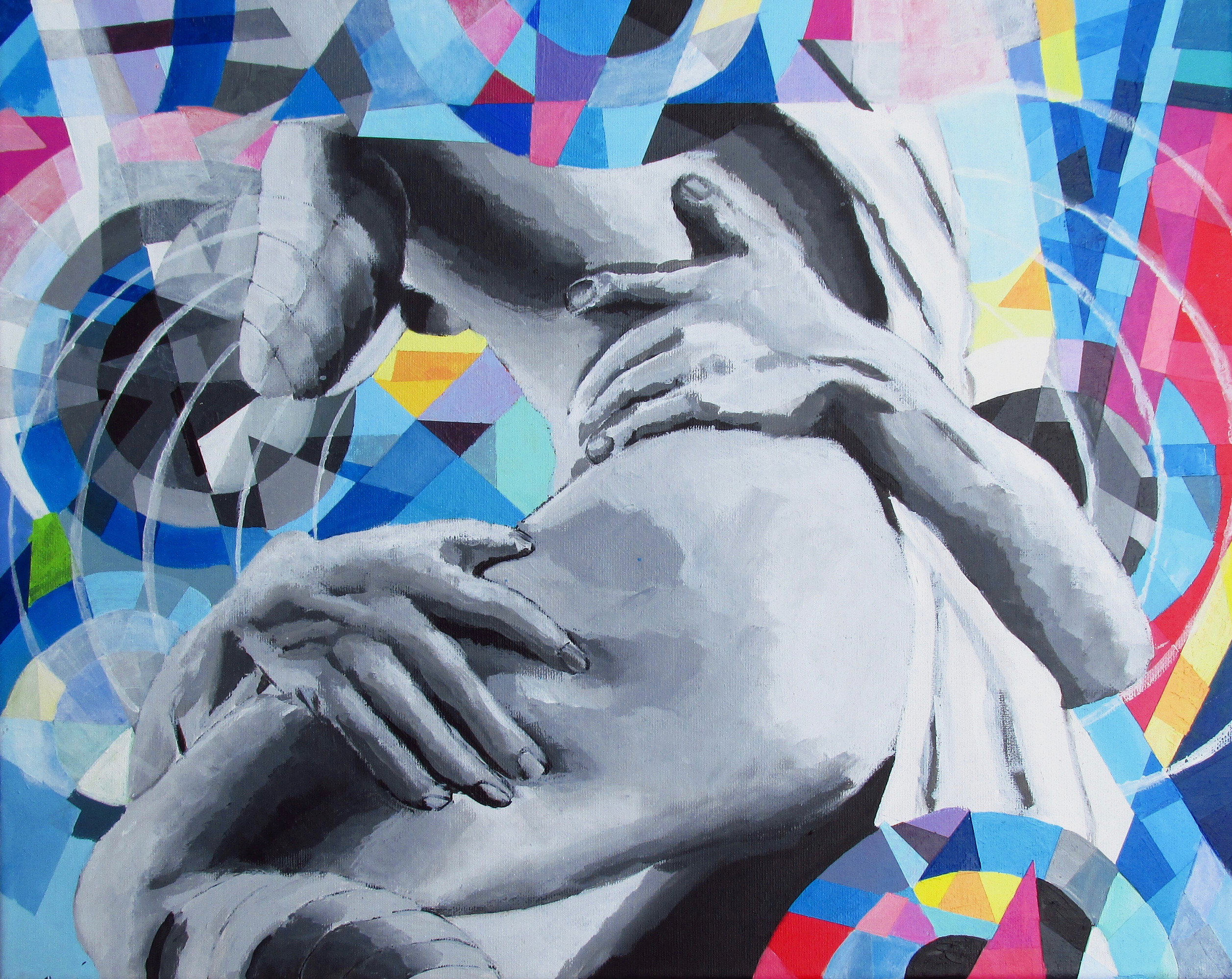
[/vc_column_text][/vc_column][/vc_row][vc_row equal_height=”yes” content_placement=”middle” full_width_header_sticky=”0″ initial_loading_animation=”none” hongo_enable_responsive_css=”1″ responsive_css=”.hongo_responsive_1611490430426{margin_top_laptop:-200PX|padding_top_laptop:-300PX|margin_top_mobile:-40px},”][vc_column hongo_column_animation_style=”fadeIn” width=”1/2″ hongo_bg_image_type=”cover-background” hongo_enable_responsive_css=”1″ offset=”vc_col-md-6″ responsive_css=”.hongo_responsive_1611491069424{margin_bottom_mobile:30px},” hongo_column_animation_duration=”1200″][vc_column_text]It’s interesting when you look at Melissa’s pieces, you can genuinely see the layers she speaks too, whether that’s her technique of building the acrylic on top of each other, or her use of patterns and colours her work forces you to look deeper, honestly, I’m not sure if that’s something she does on purpose but it feels like a nudge to view art more frequently in person, in todays world it’s so easy to view things online but I have to agree nothing beats physically seeing art up close and personal (most of us know this, but unfortunately we have also succumbed to life in a digital world, I’m definitely guilty of that). Naturally, I gravitate to Melissa’s work as she’s not afraid to use colour (if you’re new to The PanBlack Tone checkout our first article with Aya Africa in Dec 2020, and our IG @the_panblack_tone will help to give more context of our unconditional love for colour), it’s evident in her work that she is attracted to bold colours that are deliberately used to grab attention and defines colour as a connection to her Haitian origins.
THE PANBLACK TONE: I often find that artists across the afro diaspora use a lot of colour and patterns, that seemingly is influenced by their culture, would this be true for you?
MELISSA ROMULUS: Yes, especially lately, I try to use a lot of the same images and colours to connect a lot of the pieces because they have a lot of the same themes going on, especially more recently they’ve been about systems, culture, and things around that.
There was a defining moment in our conversation where Melissa expanded on how colour is interpreted in her work, though some of her recent pieces have been on difficult subject matters there is an underlining beauty in some of these issues that can be articulated via colour, that for her the image doesn’t necessarily have to be dark to convey the same message.
MELISSA ROMULUS: I really started painting seriously when I was in high school, I also got my first real acrylic kit around that time because I wanted to start mimicking the paintings I was seeing when I was going to museums and from books and movies that influenced me, we had also moved to another area and I had always gone to school with the same kids, and now I wasn’t, I found spending that time by myself really forced me to cultivate those other interests that I had.
[/vc_column_text][/vc_column][vc_column hongo_column_animation_style=”fadeIn” width=”1/2″ offset=”vc_col-md-6″ hongo_column_animation_delay=”200″ hongo_column_animation_duration=”1200″][hongo_image_gallery image_gallery_type=”grid-gallery” hongo_column=”1″ image_gallery=”106740″][vc_column_text]Grab, Acrylic on canvas, 16×20, June 2017[/vc_column_text][hongo_image_gallery image_gallery_type=”grid-gallery” hongo_column=”1″ image_gallery=”106741″][vc_column_text]Malfunction, Acrylic spray paint on canvas, 16×20, 2015[/vc_column_text][/vc_column][/vc_row][vc_row equal_height=”yes” content_placement=”middle” full_width_header_sticky=”0″ initial_loading_animation=”none” hongo_enable_responsive_css=”1″ responsive_css=”.hongo_responsive_1611490290923{margin_top_laptop:-200PX|padding_top_laptop:-300PX|margin_top_mobile:-10px},”][vc_column hongo_column_animation_style=”fadeIn” width=”1/2″ hongo_enable_responsive_css=”1″ offset=”vc_col-md-6″ responsive_css=”.hongo_responsive_1611492194810{margin_top_mobile:-30px|margin_bottom_mobile:30px},” hongo_column_animation_duration=”1200″][vc_column_text]There’s definitely a common thread in Melissa’s approach where she implements a theme using pattern to connect her pieces, in her recent work she often incorporates circles that symbolize cyclical issues that we have in society, in essence the subject isn’t new it’s just been remixed into a variation of the same issue, a perpetual cycle where we continue to spin around, you can see this in “In Wake” and “The Gift of Hypocrisy” .
[/vc_column_text][/vc_column][vc_column hongo_column_animation_style=”fadeIn” width=”1/2″ offset=”vc_col-md-6″ hongo_column_animation_delay=”200″ hongo_column_animation_duration=”1200″][hongo_video hongo_video_type=”html5-video” video_muted=”0″ video_loop=”0″ mp4_video=”https://staging.aya.africa/wp-content/uploads/2021/03/in-wake-gift-of-hypocrisy.mp4″][vc_column_text]**PLAY AUDIO**
[/vc_column_text][/vc_column][/vc_row][vc_row content_placement=”middle” full_width_header_sticky=”0″ hongo_enable_responsive_css=”1″ responsive_css=”.hongo_responsive_1611491812589{margin_top_laptop:-200PX|margin_bottom_laptop:-200px|margin_top_mobile:-50px},”][vc_column desktop_alignment=”text-center” desktop_mini_alignment=”md-text-center” ipad_alignment=”sm-text-center” mobile_alignment=”xs-text-center” hongo_enable_responsive_css=”1″ responsive_css=”.hongo_responsive_1611492102502{margin_top_mobile:-50px},”][vc_column_text hongo_enable_responsive_css=”1″ css=”.vc_custom_1616737095469{margin-bottom: 0px !important;}” responsive_css=”.hongo_responsive_1616737095471{padding_top_laptop:50PX},”]